
© Wolfgang Forstmeier
Bat Species of the Year 2024-25: The Greater Mouse-Eared Bat December 2023
Bat Species of the Year 2024-25: The Greater Mouse-Eared Bat
December 2023
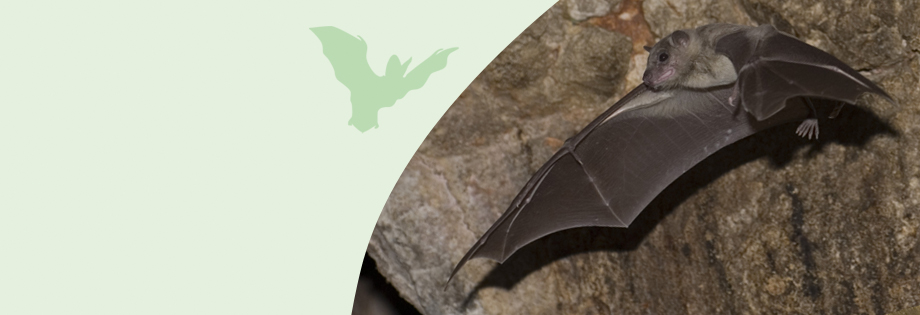
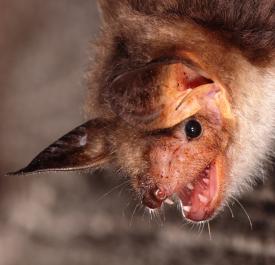
The Greater Mouse-Eared Bat has been selected as ‘Bat Species of the Year 2024-2025’ by the partners of BatLife Europe.
The Greater Mouse-Eared Bat is widespread in Europe (except the northern parts), where populations are recovering from large historical declines in the latter half of last century. To survive, this species needs a variety of key habitats throughout the year. In large parts of Europe, females raise their young in the quiet attics of large buildings and hunt for food in semi-natural deciduous forests or across meadows and pastures in the cultivated landscape. For hibernation, mouse-eared bats need stable microclimatic conditions for months, which they find in natural caves.
Kit Stoner, Chair of BatLife Europe: “The Greater Mouse-Eared Bat is linked to humans in a special way - in many European countries the females choose cultural monuments such as churches and castles for their nursery roosts, showing us how much humans are responsible for the survival of bats and the importance of a network of cultural and natural landscapes. By selecting the Greater Mouse-Eared Bat as ‘Bat Species of the Year 2024-2025’, BatLife Europe and its partners aim to highlight conservation issues, but also best practices implemented everywhere in Europe for the protection of this species.
Talk on the Greater Mouse-Eared Bat by Dr Andreas Zahn
Talk on the Greater Mouse-Eared Bat by Dr Andreas Zahn
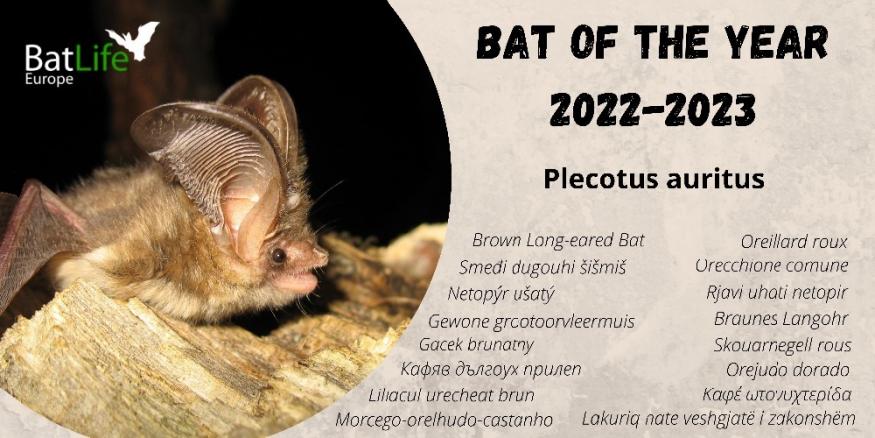
The Brown Long-eared Bat announced as the Bat Species of the Year 2022-23 January 2022
The Brown Long-eared Bat announced as the Bat Species of the Year 2022-23
January 2022
Bat of the Year 2020-21: Barbastelle
Bat of the Year 2020-21: Barbastelle
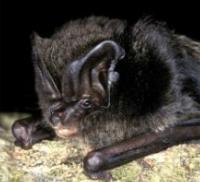
The Barbastelle is rare in Europe, and, as a typical bat of old and diverse woodland, is a great indicator of the health of the forest ecosystem. It faces similar threats across Europe, which requires a close collaboration and communication at the continental scale for its conservation. By selecting Barbastelle as ‘Bat Species of the Year 2020-2021’, BatLife Europe and its partners aim to highlight conservation issues but also best practices implemented everywhere in Europe for the protection of this species.
© Hugh Clark / Bat Conservation Trust
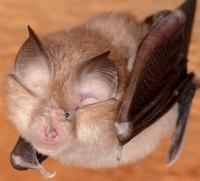
© W. Forstmeier
Bat of the Year 2018-19: Lesser horseshoe bat (Rhinolophus hipposideros)
Bat of the Year 2018-19: Lesser horseshoe bat (Rhinolophus hipposideros)
BatLife Europe partners voted the lesser horseshoe bat as Bat of the Year 2018-19.
The lesser horseshoe bat is a very small species weighing only 5-9 g. This species heavily depends on human activities because it uses buildings and other man-made structures as nursery roosts. Houses, churches and other buildings are used for their young to rear in summer. The preferred feeding habitats are woodland, hedgerows and orchards where lesser horseshoe bats hunt moths, crane flies, lacewings, and other insects. During winter it can be found hibernating in caves, tunnels, mines and cellars.
Bat of the Year 2016-17: Noctule (Nyctalus noctula)
Bat of the Year 2016-17: Noctule (Nyctalus noctula)
In 2016 BatLife Europe asked its partners to vote for their 'Bat of the Year', and they chose the Noctule!
This fascinating species is a long distance migrant and, as such, is a perfect example of how one must look beyond borders and cooperate internationally to conserve sensitive species.
The distribution of the Noctule covers vast areas of Europe. While its breeding areas are located mainly in the north-east, it hibernates mainly in south-western or southern parts of Europe. The Noctule is a typical forest species but it also uoccurs in other habitats, and even in cities, provided that there are enough old trees present.
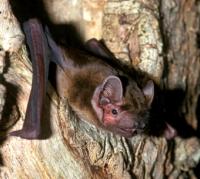
(c) Hugh Clark / Bat Conservation Trust
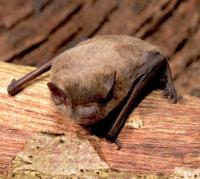
(c) Hugh Clark / Bat Conservation Trust
Bat of the Year 2015: Nathusius Pipistrelle (Pipistrellus nathusii)
Bat of the Year 2015: Nathusius Pipistrelle (Pipistrellus nathusii)
The Batlife Europe trustees chose the first Bat of Year species, the Nathusius' Pipistrelle. The species is found throughout most of Europe with individuals migrating over huge distances and travelling through many countries. It is the perfect species to illustrate how European NGOs can work together to promote and carry out bat conservation.